A day in the life, from the inside.
The mechanics are easier to feel than to define. So here's one ordinary day — imagined, but built strictly from how the model is meant to work — followed from before dawn to after dark, through a handful of ordinary lives.
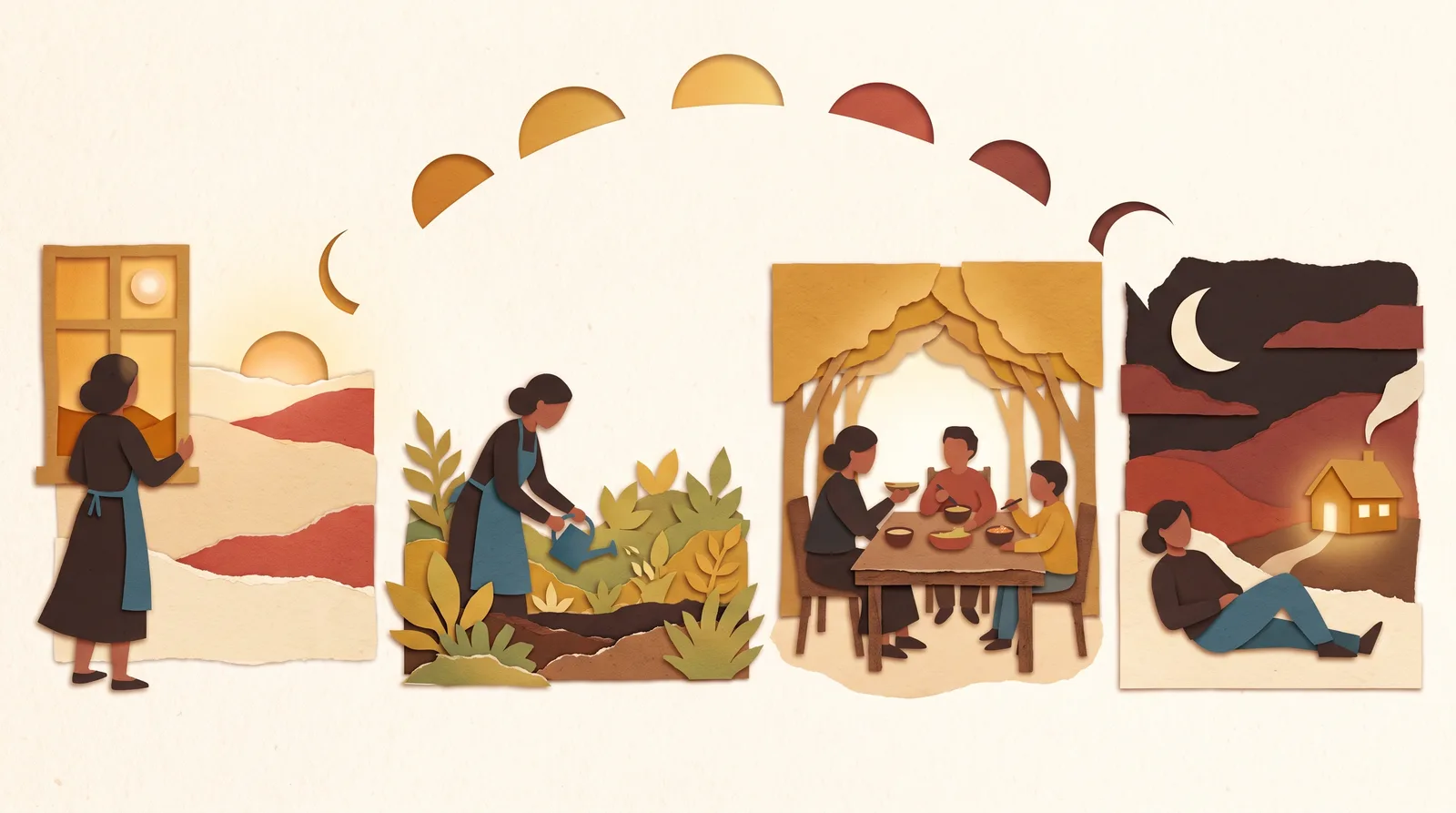

The town runs with no one in charge of it
The streetlights are still on when Wen starts her rounds. There's no city hall issuing orders, no manager assigning shifts — and yet bread is proving, the clinic is stocked, the buses are warming up. Things get done the way a path forms across a field: each person doing the next useful thing, leaving signals others can follow. Wen is a coordinator — not a boss, but a matchmaker who spends her day connecting people who need something with people who can provide it. Anyone can play her role; she does it because she's good at it and it's visibly needed.
no rulerscoordination, not commandNobody wakes up worried about rent
Maya opens her eyes in a home that is simply hers. Breakfast is on the table; her daughter's school and the clinic down the road cost nothing to use. None of this had to be earned — necessities are free, for everyone, for life. What that removes from the morning is a low hum of fear most of us stopped noticing: the daily arithmetic of survival. She doesn't spend the first hour of her day doing math about money she doesn't have. She gets to think about her day instead.
free necessitiesno rent, no billsA bakery opens without a loan
Across town, Idris unlocks a bakery he opened three weeks ago. He didn't buy the space, the oven, or the sacks of flour — a coordinator connected him with the people and workshops who provide them, all at no cost. The tools of the trade, the capital goods, are free to those who'll put them to good use. No invoice changes hands and no debt is taken on to begin. And the older bakery two streets over? They compete, plainly — better bread gets chosen, and reward follows the loaves people actually eat. What that baker can never do is take Idris's living, or Idris his. Losing here costs you reward. It doesn't cost you the oven, the flour, or the roof over your head.
capital goods, freeno debtMatching needs to hands, all day
By late morning Wen has linked a retired engineer to a group rebuilding a footbridge, and steered a shipment of timber to whoever will waste the least of it. She holds no authority to command anyone; what she has is a reputation for good matches, earned in the open, and that's what makes people bring her their problems. Do the job well and the reputation grows and better opportunities flow your way; do it badly and they don't. It's influence you win by being trusted, not power you're handed.
reputation, earnedinfluence ≠ powerSomeone still clears the drains — and it pays
Tomas spends his afternoon deep in the storm drains before the rainy season. It's cold, unglamorous, essential work — exactly the kind we're told "no one would do" without the whip of a wage. But reward here follows benefit, and preventing a flood that would ruin a thousand homes scores enormously. So the hard, necessary jobs are among the best-rewarded in Copiosis, not the worst-paid. The dirty job isn't a trap you're stuck in by poverty; it's a contribution the whole system openly prizes.
the hard jobs pay wellreward follows benefitThe good gets measured, quietly
As people are fed, healed, taught, and kept safe, the benefit created is measured — continuously, in the background — and Net Benefit Reward appears for the people who made it, each amount sized to the good they helped produce. Maya's reflects the health she helped restore. Idris's reflects the bread and the small daily joy of it. And it doesn't stop with them: the miller who ground the flour, the coordinator who made the introductions, the person who taught Idris to bake — everyone in the chain is recognized for their part. Good rarely has a single author, and the reward notices that.
NBR, sized to contributionthe whole chainThe greener choice is also the smart one
Priya is finishing a community workshop and has two ways to roof it: a cheap material that off-gasses and won't be recyclable, or reclaimed timber that takes more care to fit. In a money economy the nasty option often wins because its damage is someone else's problem. Here, harm is subtracted from her reward — the pollution would count against her — so the timber isn't a sacrifice she makes for the planet. It's simply the better move. Protecting the world stops fighting against the incentives and starts riding with them.
harm subtractsthe planet dividendReward is for the extras — and then it's gone
Maya spends some of her reward on a beautiful cello for her daughter — a luxury, unlocked with NBR, which simply disappears as she uses it. She doesn't need to hoard it here — though she could; an NBR balance can grow without limit. The basics were never at stake, and because NBR can never change hands, no amount of it becomes a lever over anyone else. The rest of her satisfaction isn't something she spends at all: it's the day itself — work she chose, that visibly made life better, and was seen to.
luxuries via NBRspend-and-it's-goneA newcomer, still getting used to it
Sam grew up counting every dollar and still catches himself waiting for the catch — the bill that never comes, the boss who never appears, the trick behind "your needs are just covered." Trust like that isn't installed overnight; it's built one uneventful week at a time, as the fear slowly fails to come true. Copiosis doesn't ask you to be a saint on day one. It's honest that a life without money-fear takes some getting used to — and that the getting-used-to is part of the point.
honestly, it's an adjustment The negative space
What you'd notice is missing
Some of the biggest changes aren't things that happen — they're things that simply never come up all day:
Keep exploringThe machinery behind the day
The Payment Algorithm
How "the good gets measured" actually works — good minus harm, turned into a number.
Read this →Who Actually Runs It
Coordinators, citizen juries, and order without a boss — the role Wen was playing all day.
Read this →NBR, in Depth
The reward Maya spent on that cello — why it's created from nothing and vanishes when used.
Read this →How is any of this measured?
The whole day rests on one quiet engine: an open formula that turns "good work" into a reward. Here's exactly how it works.
The payment algorithmBack to Deep Dive