Money carried us far. Here's where it strains.
No villains here — just structure. Debt, scarcity, blindness to harm, and a few other limits are baked into how money works. Naming them plainly is what makes the case for a new yardstick.
 Fair credit first
Money got us a long way
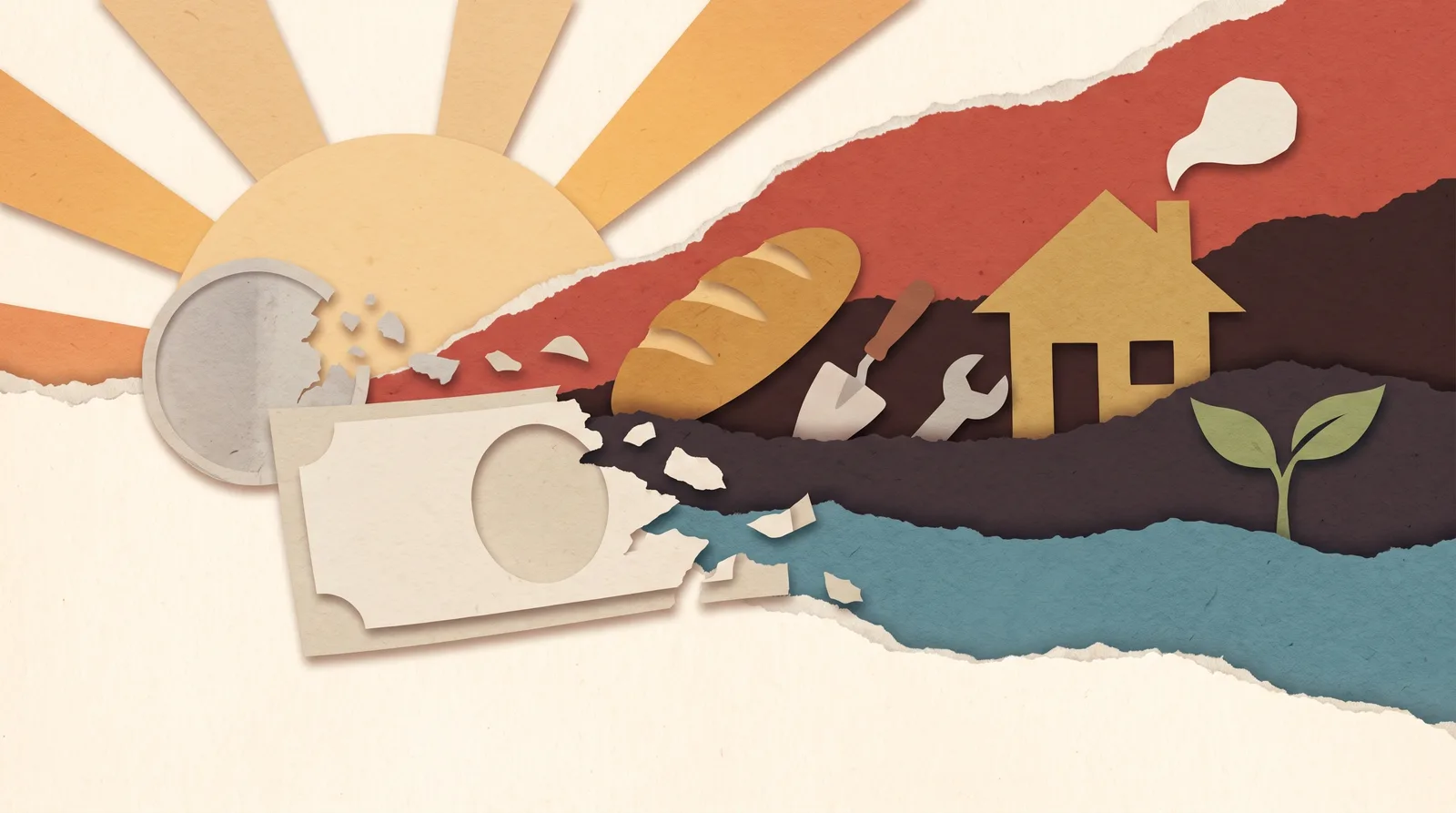
Money is one of humanity's great inventions. It gave strangers a way to cooperate without trust, turned effort into something you could store and carry, and set a common scale so wildly different things could be compared and traded. Those three jobs — a medium of exchange, a store of value, a unit of account — helped lift billions out of poverty. Copiosis isn't here to sneer at any of it.
But a tool can be brilliant at its job and still carry structural problems it can't shake — properties that come bundled with the design, not from anyone misusing it. Those are worth naming plainly, because they're the ones a new approach would have to answer.
 At a glance
What it does well, where it strains
The strains, in fullFive that come with the design
Born from debt, built to be scarce
Most modern money is created when someone borrows — it comes into being as debt, with interest owed on top. That means there's always more owed than exists, which builds a permanent, low-grade scramble into the system: someone must always be borrowing, growing, and competing just to keep the whole thing from seizing up. Scarcity isn't an accident of money; it's closer to a design feature.
It can't tell help from harm
A dollar earned polluting a river spends exactly like a dollar earned cleaning it. Money is morally blind — it records that a transaction happened, never whether the world got better or worse. So harms with no price tag (a poisoned aquifer, a burned-out worker, a heated planet) become someone else's problem, or no one's.
Pile enough unpriced harm up and you get an economy that can grow and degrade at the same time — and call it success.
It measures the wrong thing
We track a society's health mostly by how much it spends — GDP. But spending and wellbeing aren't the same. A disaster that forces a wave of rebuilding lifts GDP; a quiet year where people are simply content may not. When the yardstick is activity rather than benefit, you optimize for motion, not for lives actually going well.
It makes survival conditional
Because you need money for food, shelter, and care, you must obtain it somehow — which means need itself can push people into bargains they'd never otherwise take. A job that's unsafe, a wage that's unfair, work that does no real good: money quietly turns "or you don't eat" into a bargaining chip. Much of what looks like free choice in a money economy is choice under the pressure of survival.
It turns into power
Because money stores and accumulates, it tends to concentrate — and concentrated money doesn't stay merely economic. It buys attention, access, and influence over the very rules everyone else has to play by. That feedback loop, where wealth writes the rules that produce more wealth, isn't a scandal bolted onto money; it follows naturally from something you can pile up without limit.
The honest frameThese are the operating logic, not bugs
The turnA better yardstick
Keep exploringRelated deep dives
NBR, in Depth
The replacement — created from nothing, impossible to transfer, gone when spent.
Read this →The Payment Algorithm
How the new yardstick — good minus harm — actually becomes a number.
Read this →vs. the Alternatives
How this differs from capitalism, socialism, UBI, and resource-based economies.
Read this →So what replaces it?
If the yardstick becomes benefit-minus-harm, the reward becomes NBR — created from nothing, impossible to transfer.
NBR, in depthBack to Deep Dive